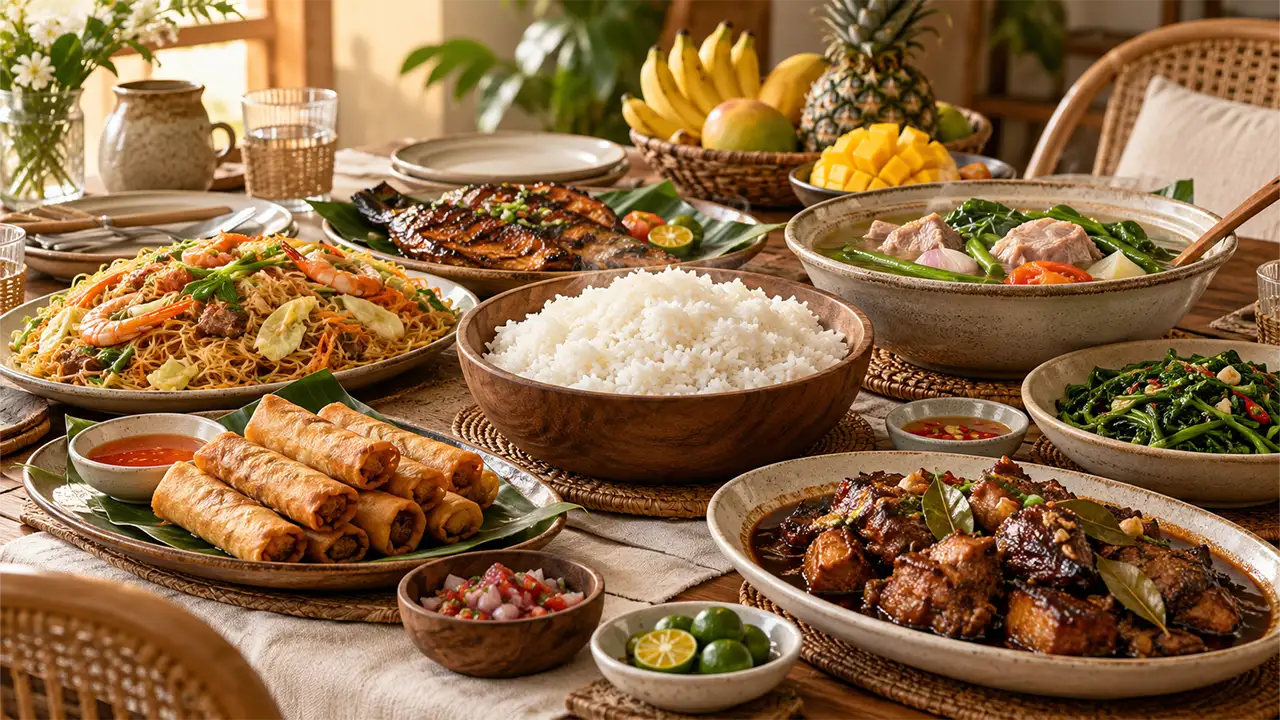
Filipino Food Culture: Traditions, Flavors, Everyday Meals and Iconic Dishes
Filipino food culture is shaped by an archipelago of thousands of islands, hundreds of communities, tropical ingredients, regional foodways, family traditions, and centuries of cultural exchange. Adobo may be one of the country’s most recognized dishes abroad, but it represents only one part of a much larger culinary story.
Across the Philippines, food can be sour, savory, sweet, salty, rich with coconut milk, bright with vinegar or citrus, or deeply flavored with fermented condiments. Rice anchors countless meals, while local seafood, vegetables, pork, chicken, tropical fruits, noodles, root crops, and coconut take different forms from one region to another.
To understand Filipino cuisine, it helps to look beyond individual recipes. Food in the Philippines is connected with geography, trade, migration, family, celebration, resourcefulness, and the ingredients available in a particular place.
What Is Filipino Food Culture?
Filipino food culture is the collection of cooking traditions, ingredients, regional cuisines, eating practices, celebrations, family customs, and historical influences connected with food in the Philippines.
It is not one uniform cuisine. Filipino dishes vary according to island, province, ethnic community, climate, agriculture, fishing traditions, religion, trade history, and family practice.
The Philippines formally recognizes culinary traditions as part of its cultural heritage. Since 2018, the country has observed April as Buwan ng Kalutong Pilipino, or Filipino Food Month, with the goal of helping preserve, appreciate, and pass Filipino culinary heritage to future generations.
This idea of food as cultural heritage is important. Recipes are not simply instructions for combining ingredients. They can preserve memories, regional identities, agricultural knowledge, family traditions, and the history of communities.
How an Archipelago Created Many Regional Cuisines
The Philippines is one of the world’s largest archipelagic countries, with more than 7,000 islands. That geography has helped create an extraordinary range of local food traditions.
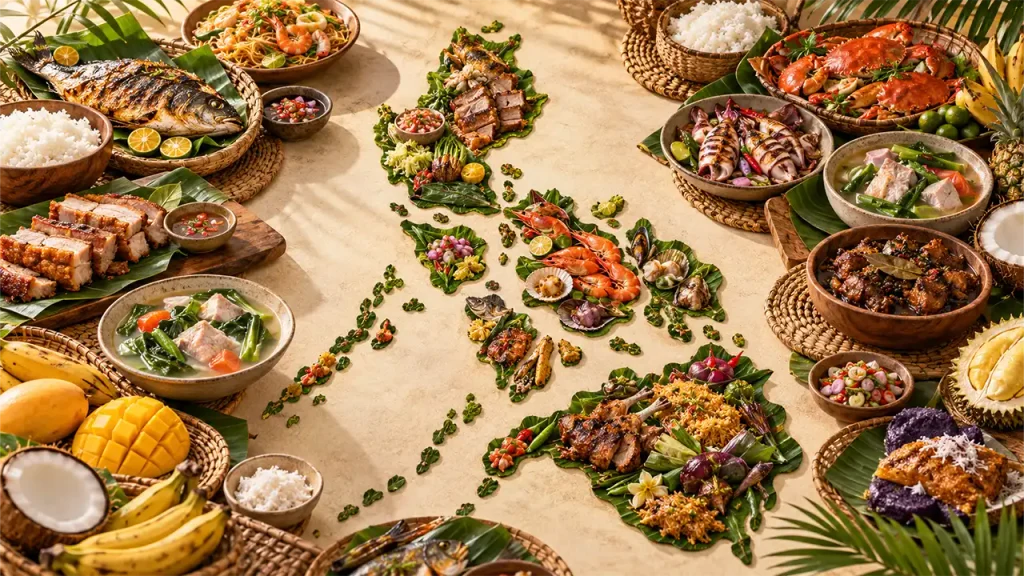
Coastal communities naturally developed strong relationships with fish and seafood. Agricultural areas created cuisines around rice, vegetables, coconuts, fruits, livestock, and regional crops. Mountain communities, tropical lowlands, major trading ports, and isolated islands all developed different ways of preserving and preparing food.
This is why a dish from Bicol can taste dramatically different from one associated with Ilocos, Pampanga, Cebu, Iloilo, or Mindanao.
Even when two regions prepare dishes with similar names, the ingredients and techniques may differ. Filipino cuisine is therefore best understood as a network of regional cuisines connected by shared ingredients and eating traditions rather than as one fixed national menu.
Why Rice Is Central to Filipino Meals
Rice is one of the foundations of everyday Filipino food culture. Many dishes are designed to be eaten with steamed rice rather than as complete dishes on their own.
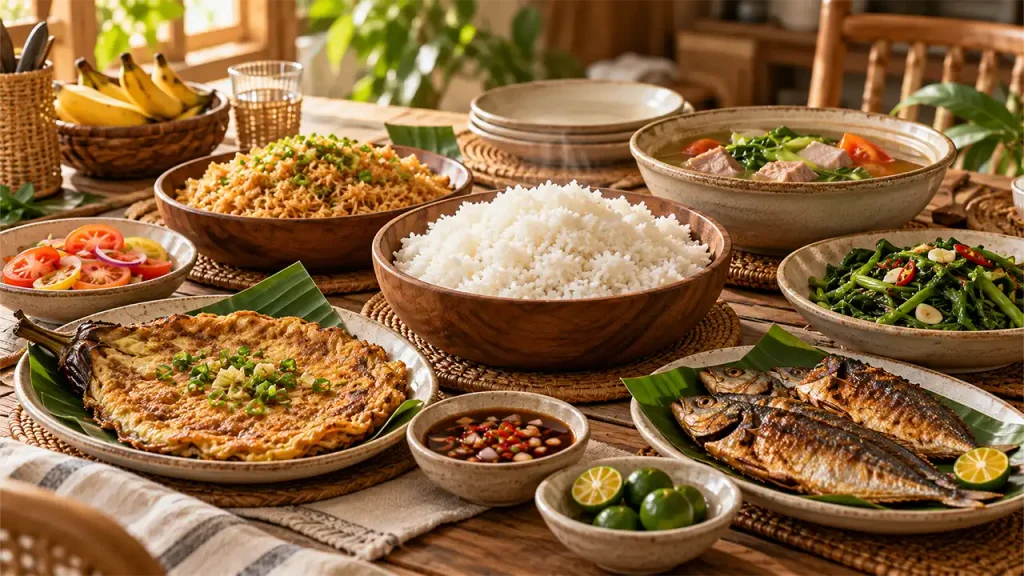
The Filipino idea of ulam helps explain this relationship. Ulam is the savory dish eaten with rice. It might be meat, seafood, vegetables, soup, eggs, or another preparation, while rice provides the neutral base around which the meal is built.
Rice also appears in many other forms. Leftover rice can become garlic fried rice for breakfast. Glutinous rice is used in numerous sweets and rice cakes. Rice may be wrapped in leaves, cooked with coconut milk, transformed into porridge, or served during festivals and family gatherings.
Try it at home: Our Filipino Arroz Caldo transforms rice into a comforting chicken and ginger porridge often served with toppings such as scallions, crisp garlic, egg, and citrus.
Sour, Salty, Sweet and Savory Filipino Flavors
Filipino cooking is often described through contrasts. A meal may combine sourness, saltiness, sweetness, richness, and savory depth rather than focusing on one dominant flavor.

Sourness
Acidity plays an especially important role. Vinegar, calamansi, tamarind, tomatoes, and other sour fruits or ingredients can brighten rich foods, preserve ingredients, or form the foundation of an entire dish.
Sinigang is perhaps the clearest example. Its defining characteristic is not a particular meat or vegetable but a distinctly sour broth.
Salty and Savory Flavors
Soy sauce, fish sauce, salt, dried seafood, and fermented products contribute savory depth to many Filipino dishes.
Bagoong, a fermented fish or shrimp condiment, appears in different regional forms and can be served beside dishes or incorporated directly into cooking. Patis, or fish sauce, is another important seasoning.
Sweetness
Sweetness is not limited to dessert. Some savory Filipino foods combine sugar with salt, soy sauce, meat, or acidic ingredients.
Tocino is an easy example: the cured meat is known for its savory-sweet character and is commonly served as part of breakfast with garlic rice and egg.
Explore breakfast: Try our Filipino Tocino Breakfast with Garlic Rice and Egg.
How History and Cultural Exchange Shaped Filipino Food
Filipino cuisine developed through centuries of local adaptation and cultural exchange. Long before European colonization, communities across the islands already relied on local rice, seafood, meat, vegetables, coconuts, fruits, fermentation, grilling, boiling, steaming, and souring techniques.
Trade and migration then brought additional ingredients and food traditions. Chinese communities had an especially important influence on noodle dishes and foods such as lumpia.
Chinese Influences and Pancit
Pancit is one of the clearest examples of a food tradition that arrived through Chinese cultural exchange and became distinctly Filipino.
Instead of remaining one standardized noodle dish, pancit developed into numerous regional forms using different noodles, proteins, vegetables, sauces, and garnishes.
Noodles also became closely connected with birthdays and celebrations, where their long shape is commonly associated with long life.
Try it at home: Our Filipino Pancit Canton with Chicken is an approachable introduction to Filipino noodle cooking.
Lumpia and Adaptation
Lumpia also reflects Chinese influence and Filipino adaptation. Different versions can be fresh or fried and filled with meat, seafood, vegetables, or combinations of ingredients.
Lumpiang Shanghai, made as small fried rolls, became especially associated with parties and gatherings.
Explore the recipe: Filipino Lumpiang Shanghai.
Spanish and Trans-Pacific Influences
More than three centuries of Spanish colonial rule also left visible marks on Filipino food. Spanish names, cooking ideas, celebratory dishes, stews, custards, and techniques became part of local food traditions, but they were continually adapted to Philippine ingredients and tastes.
The Manila–Acapulco galleon trade also connected the Philippines with Mexico and the wider Americas for roughly two and a half centuries. Ingredients and food ideas moved across the Pacific in both directions.
That history helps explain why Filipino food can contain elements that seem familiar from Southeast Asian, Chinese, Spanish, Mexican, and later American cuisines while still forming a culinary identity of its own.
The important point is that Filipino cuisine is not simply a collection of borrowed dishes. Communities repeatedly transformed outside influences using local ingredients and preferences until they became part of Filipino food culture.
Adobo, Vinegar and Preservation
Adobo is one of the most internationally recognized Filipino cooking styles, but there is no single universal adobo recipe.
The term commonly refers to ingredients cooked with vinegar and aromatics, often with soy sauce, garlic, peppercorns, and bay leaves in many contemporary versions. Pork and chicken are famous choices, but seafood, vegetables, and other ingredients can also be prepared adobo-style.
Vinegar is especially important. Long before refrigeration, acidic cooking environments were useful for extending the practical life of food in a tropical climate. Over generations, preservation and flavor became closely connected.
Regional and family versions vary greatly. Some adobos are darker, others lighter. Some are saucy while others are reduced until almost dry. Coconut milk may appear in certain regional preparations, and the balance of vinegar, soy sauce, salt, sweetness, and garlic can change from household to household.
Our current FFA collection explores another side of the adobo family with Filipino Adobong Pusit, a squid preparation that demonstrates how the adobo idea can extend beyond pork or chicken.
Sinigang and the Filipino Love of Sourness
If adobo demonstrates the importance of vinegar, sinigang reveals how central sourness can be to an entire Filipino meal.
Sinigang is a Filipino sour soup or stew built around a deliberately tart broth. Pork, fish, shrimp, beef, or other proteins can be used, along with vegetables.
Tamarind is one of the best-known souring ingredients, but regional versions may rely on other fruits or acidic ingredients depending on what grows locally.
The appeal of sinigang comes from balance. The broth should be noticeably sour, but that acidity works alongside savory meat or seafood, vegetables, and hot steamed rice.
Try it at home: Our Filipino Pork Sinigang with Tamarind provides a beginner-friendly introduction to this important flavor tradition.
Coconut Milk and Regional Cooking
Coconut grows throughout much of the Philippines and appears in both savory foods and desserts. Coconut milk, coconut cream, young coconut, grated coconut, and other coconut products can all play different roles in Filipino cooking.
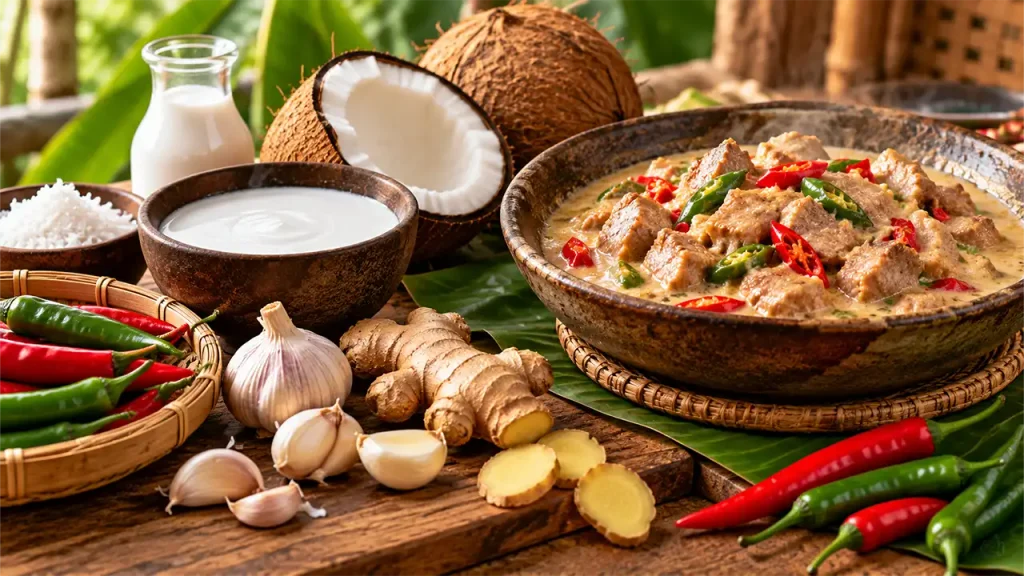
Dishes cooked in coconut milk are often described using the word ginataan, although ingredients and regional styles vary enormously.
Explore a vegetable-forward example: Our Filipino Ginataang Langka combines young jackfruit with coconut milk for a creamy stew.
Bicol and Coconut-Chile Cooking
The Bicol region is particularly famous for cooking that combines coconut milk with chile peppers.
Bicol Express is one of the best-known examples. Rich coconut milk provides body while chile adds heat, creating a combination quite different from the sour broths or vinegar-forward dishes associated with other parts of the country.
Try it at home: Filipino Bicol Express.
What Do Filipinos Eat in Everyday Meals?
Everyday Filipino meals are much more varied than the dishes most commonly seen on international restaurant menus.
A typical home meal may combine rice with one or more ulam dishes: fish, meat, vegetables, eggs, soup, or a stew. Condiments may be placed on the table so each person can adjust acidity, saltiness, or heat.
Filipino Breakfast
Breakfast can be substantial. Garlic fried rice, eggs, and a protein form one familiar style of morning meal.
The popular family of breakfast combinations often called silog meals combines sinangag, or garlic rice, with itlog, meaning egg, and another main ingredient.
Tocino is particularly well suited to this format because its sweet-salty flavor contrasts with garlic rice and fried egg.
Simple Home Dishes
Some Filipino dishes are remarkably straightforward. Tortang talong, for example, transforms eggplant and eggs into a practical meal that can be eaten with rice.
Explore the recipe: Filipino Tortang Talong.
Other meals are built around slow-simmered stews. Mechado, for example, reflects another branch of Filipino comfort food: meat cooked until tender in a flavorful tomato-based sauce.
Try our version: Filipino Beef Mechado.
Soup and Porridge as Comfort Food
Soup and rice porridge are also important comfort foods.
Arroz caldo combines rice, chicken, ginger, garlic, and broth into a warm porridge that works especially well when someone wants something soothing and filling.
Sinigang provides another kind of comfort: steaming broth with vegetables and a strong sour character.
These dishes show why Filipino comfort food cannot be described by richness alone. Comfort can come from sourness, ginger, warm broth, rice, familiar aromas, and foods associated with family care.
Regional Filipino Food: One Country, Many Traditions
Regional diversity is one of the most important ideas in Filipino food culture. A short list of national dishes cannot represent the foodways of an entire archipelago.
Luzon
Luzon includes several important culinary regions, each with its own traditions.
Ilocano cooking is known for dishes built around local vegetables, fermented condiments, and strong contrasts of flavor.
Pampanga has long been associated with an especially rich culinary tradition and dishes such as sisig and tocino.
Bicol stands apart for its particularly visible use of coconut milk and chile, represented by dishes such as Bicol Express.
Visayas
The Visayas contain numerous island and provincial cuisines shaped by seafood, local agriculture, trade, and distinct regional histories.
Cebu is internationally associated with lechon, while Iloilo has well-known food traditions surrounding dishes such as La Paz batchoy, pancit molo, and regional stews.
Other communities across the Visayas maintain their own rice cakes, seafood preparations, coconut dishes, soups, and foods wrapped in leaves.
Mindanao
Mindanao adds another major layer to Filipino culinary diversity.
Moro communities, Indigenous peoples, migrant communities, coastal populations, and agricultural regions all contribute different ingredients and traditions. Spices, grilled foods, rice, coconut, turmeric, seafood, and regional meat preparations can take forms that differ significantly from foods associated with Manila or central Luzon.
There is therefore no single regional cuisine that can stand for “Mindanao food” any more than one dish can represent the Philippines as a whole.
Food, Family and Filipino Celebrations
Food is closely connected with hospitality and family life in the Philippines. An invitation to eat can be a simple way of welcoming someone into a home or gathering.
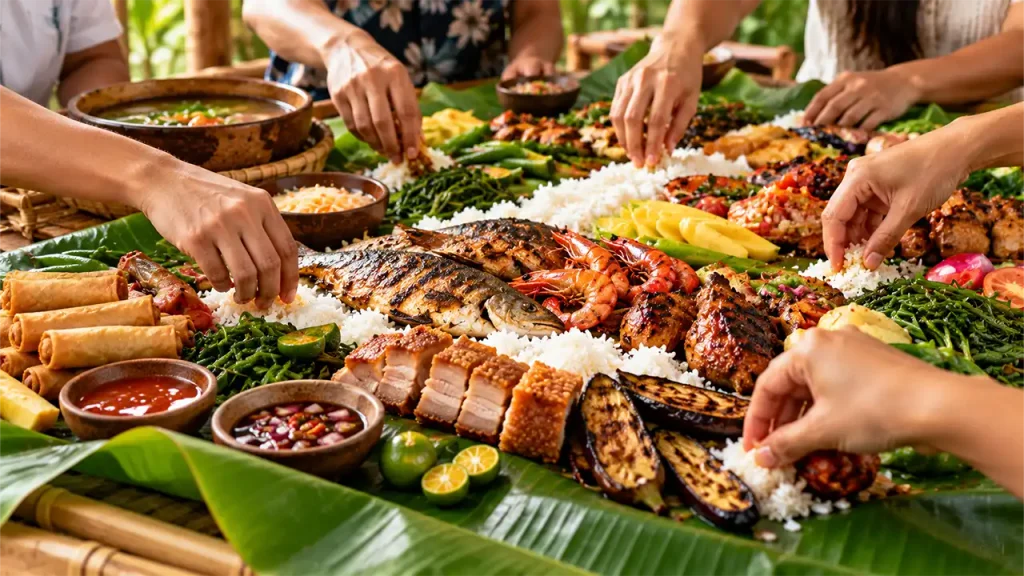
Family meals are important not only because of what is served but because food creates a reason to gather, talk, celebrate, and care for one another.
Fiestas and Special Occasions
Birthdays, fiestas, Christmas gatherings, reunions, weddings, and other celebrations often feature dishes prepared in larger quantities than an ordinary weekday meal.
Pancit commonly appears at celebrations. Lumpiang Shanghai is easy to share with a crowd. Large meat dishes, rice, desserts, noodles, and trays of food help turn a meal into a communal event.
Kamayan and Communal Eating
Kamayan refers to eating with the hands, a long-standing Filipino way of eating that continues in both ordinary and celebratory contexts.
One especially visual communal presentation is the boodle fight, where several foods may be arranged across banana leaves and shared by a group eating with their hands.
Not every Filipino meal is eaten this way, of course, but the continued popularity of kamayan-style gatherings illustrates an important theme in Filipino food culture: a meal can be about participation and togetherness as much as individual plates.
Filipino Desserts, Merienda and the Sweet Side of Food Culture
Filipino food culture has an especially rich world of sweets and snacks.
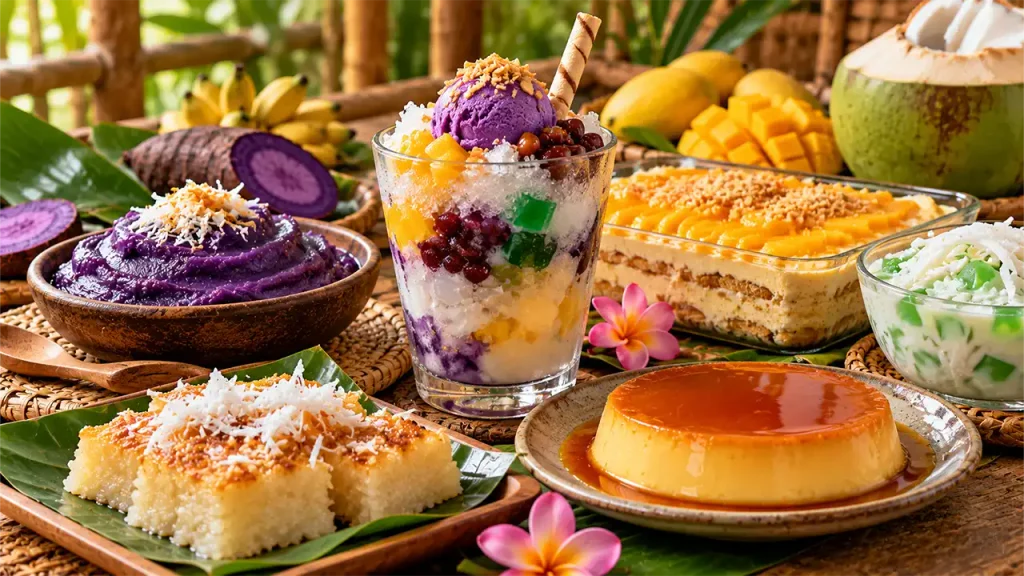
Merienda refers broadly to a snack or lighter meal eaten between the day’s main meals. Depending on the household and region, merienda might mean noodles, bread, rice cakes, fried snacks, fruit, or something sweet.
Ube
Ube, or purple yam, has become internationally recognizable because of its vivid purple color, but in the Philippines it has a much longer place in desserts.
One important preparation is ube halaya, a thick purple yam jam or pudding that can be eaten on its own or incorporated into other sweets.
Explore the recipe: Filipino Ube Halaya.
Halo-Halo
Halo-halo—literally associated with the idea of mixing—layers crushed or shaved ice with an assortment of sweet ingredients.
Recipes vary widely, but beans, fruit, jellies, sweetened ingredients, milk, ube, leche flan, and ice cream can all appear.
The dessert’s exact history is complex and debated. Like much of Filipino cuisine, it reflects layers of cultural exchange and continual adaptation rather than one simple origin story.
Try our family-friendly version: Filipino Halo-Halo Inspired Dessert Cups.
Leche Flan
Leche flan shows another side of Filipino culinary history. This rich caramel custard reflects Spanish influence but developed into a deeply familiar Filipino celebration dessert of its own.
Explore the recipe: Filipino Leche Flan.
Coconut, Cassava and Tropical Ingredients
Cassava, coconut, pandan, mango, banana, jackfruit, and glutinous rice appear repeatedly across Filipino sweets.
Our Filipino Cassava Cake combines grated cassava with a rich coconut-based mixture.
Buko Pandan highlights young coconut and pandan in a cool, creamy dessert.
Filipino Mango Float layers ripe mango with cream and crackers for a popular no-bake refrigerator dessert.
For another coconut-based sweet, Ginataan Bilo-Bilo combines coconut milk with chewy glutinous rice balls and other sweet ingredients.
Filipino Food Culture Today
Filipino cuisine continues to evolve in the Philippines and throughout the global Filipino diaspora.
Traditional dishes remain important, but cooks continually reinterpret them according to ingredient availability, family preference, health needs, migration, restaurant culture, and new culinary techniques.
Filipino restaurants outside the Philippines may serve recognizable classics alongside dishes designed around ingredients available in the United States, Canada, Europe, the Middle East, or elsewhere.
At the same time, chefs within the Philippines continue to document regional foodways, preserve heritage recipes, work with local producers, and reinterpret traditional ingredients for contemporary diners.
This combination of preservation and adaptation is not unusual in Filipino culinary history. The cuisine has changed repeatedly while maintaining strong connections with place, memory, family, and regional identity.
Filipino Recipes to Explore at Home
Family Flavor Atlas currently has a growing collection of Filipino and Filipino-inspired recipes that can help families explore different parts of the country’s food culture.
Savory Filipino Recipes
- Filipino Pancit Canton with Chicken — noodles, chicken, vegetables, and savory sauce.
- Filipino Pork Sinigang — pork and vegetables in a bright tamarind broth.
- Filipino Arroz Caldo — comforting chicken, ginger, and rice porridge.
- Filipino Lumpiang Shanghai — crisp fried rolls for lunches and gatherings.
- Filipino Tortang Talong — eggplant and egg transformed into a practical family dinner.
- Filipino Bicol Express — a rich coconut milk and chile-based dish inspired by Bicolano flavors.
- Filipino Beef Mechado — tender beef in a comforting tomato-based stew.
- Filipino Adobong Pusit — squid prepared with an adobo-style vinegar-forward sauce.
- Filipino Ginataang Langka — young jackfruit simmered in coconut milk.
- Filipino Tocino Breakfast — sweet-savory tocino with garlic rice and egg.
Filipino Desserts
- Filipino Ube Halaya
- Filipino Halo-Halo Inspired Dessert Cups
- Filipino Leche Flan
- Filipino Cassava Cake
- Filipino Buko Pandan
- Filipino Mango Float
- Filipino Ginataan Bilo-Bilo
Watch: The Philippines Through Food — More Than Adobo
Our upcoming Family Flavor Atlas documentary, The Philippines Through Food: More Than Adobo, will explore how geography, regional traditions, rice, sour flavors, coconut, trade, migration, family life, and centuries of cultural exchange helped shape Filipino food culture.
The full documentary will be added here when it is released, allowing you to continue the journey through the Philippines with stories, visuals, and the food traditions explored throughout this guide.
Filipino Food Culture: The Bigger Picture
Filipino food culture cannot be understood through one national dish.
It is steamed rice beside a deeply flavored ulam. It is vinegar helping preserve food in a tropical climate. It is the sharp tamarind broth of sinigang. It is coconut milk meeting chile in Bicol. It is noodles adapted over generations until they become a birthday tradition. It is a family making lumpia for a celebration. It is arroz caldo offered when someone needs comfort. It is a dessert table filled with ube, coconut, mango, cassava, caramel, and crushed ice.
Most importantly, it is a living culture.
Filipino cooking continues to respond to geography, migration, trade, agriculture, economic change, family routines, and new generations of cooks. Regional foodways remain distinct while dishes also travel between islands and across the world.
Exploring the Philippines through food therefore means asking a larger question: what can the way people grow, cook, preserve, share, celebrate, and adapt food tell us about the communities they call home?
That question is at the heart of Family Flavor Atlas.
Good Food Brings Us Closer.
Frequently Asked Questions About Filipino Food Culture
What is Filipino food culture?
The Philippines formally recognizes culinary traditions as part of its cultural heritage. Since 2018, the country has observed April as Filipino Food Month, with the goal of helping preserve, appreciate, and pass Filipino culinary heritage to future generations.
What are the main flavors in Filipino cuisine?
Filipino cooking often balances sour, salty, savory, and sweet flavors. Vinegar, calamansi, tamarind, soy sauce, fish sauce, fermented condiments, coconut, garlic, and sugar are among the ingredients used to create those contrasts.
Why is rice important in Filipino cuisine?
Rice is a major staple and forms the base of countless Filipino meals. Savory dishes are commonly eaten as ulam alongside steamed rice, while rice is also transformed into porridge, fried rice, rice cakes, sweets, and ceremonial foods.
Is adobo the national dish of the Philippines?
Adobo is frequently described as one of the Philippines’ most representative and recognizable dishes, but Filipino cuisine is too regionally diverse to be reduced to one recipe. Adobo itself also exists in many regional and household variations.
Why is sourness so important in Filipino food?
Sour flavors provide balance in a tropical cuisine that can also contain rich meat, coconut milk, salt, and sweetness. Vinegar also historically had practical value for preservation, while dishes such as sinigang make acidity the defining feature of the meal.
What is a typical Filipino breakfast?
Filipino breakfast varies widely, but one familiar style combines garlic fried rice, egg, and a protein such as tocino. Rice porridge such as arroz caldo can also appear as breakfast or comfort food.
Why does Filipino cuisine have so many foreign influences?
The Philippines has a long history of maritime trade, migration, colonization, and international exchange. Chinese, Spanish, Mexican, American, and neighboring Southeast Asian connections introduced ingredients and cooking ideas that Filipino communities adapted to local tastes and ingredients.
Does Filipino food vary by region?
Yes. Regional variation is fundamental to Filipino cuisine. Geography, climate, agriculture, seafood, ethnic communities, religion, trade, and local history all influence what people cook from one province or island to another.
What is kamayan?
Kamayan is the Filipino practice of eating with the hands. It may be part of everyday eating or communal celebrations. Some modern gatherings present food across banana leaves for a shared kamayan-style feast.
Sources and Further Reading
- National Commission for Culture and the Arts — Filipino Food Month
- National Commission for Culture and the Arts — Philippine Cultural Laws and Proclamation No. 469
- Philippine Information Agency — Beyond the Flavor: What Makes Filipino Cuisine Uniquely Ours?
- Philippine Information Agency — Filipino Cuisine and Its ASEAN Heritage
- National Library of the Philippines — Bibliography on Philippine Cuisines